PISCATORS
Honoring Tradition. Exploring Innovation.

Category: Journal

  • A Brief History of the Fishing Hook—and How to Read Hook Sizes

    A Brief History of the Fishing Hook—and How to Read Hook Sizes

    “… having withall regard to the bigness or littleness of your hook” — Izaak Walton, The Compleat Angler (1653)

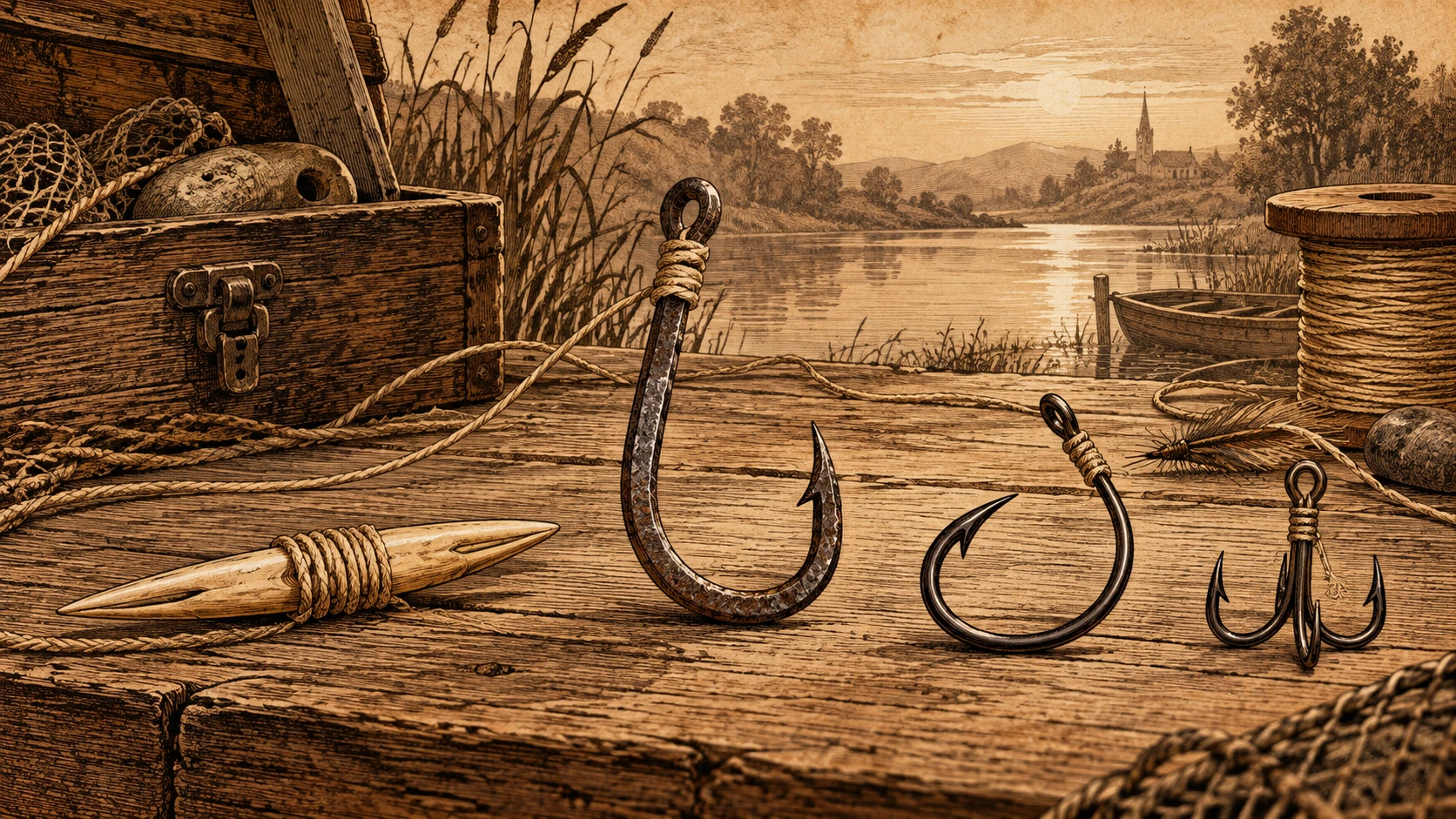
    Long before Walton wrote about fishing hooks, anglers used a simple device called a gorge: a small, straight piece of bone or wood tied to a line near its middle. A fish swallowed it, and the piece turned crosswise when the line was pulled. Hooks have changed enormously since then, but Walton’s point still holds: size matters.

    How Hook Sizes Work

    Hook labels can seem backward. In the numbered sizes, a higher number means a smaller hook: size 8 is smaller than size 4, which is smaller than size 1. After size 1, the labels switch to aughts—1/0, 2/0, 3/0—and the direction reverses: 3/0 is larger than 2/0.

    A size number does not guarantee identical dimensions across hook styles or brands. Check the gap—the opening between the point and the shank—along with the hook’s shape and wire thickness. The gap needs room for the bait while leaving the point exposed; the right size depends on what you are presenting and the fish you expect to catch.

    Shape Matters Too

    A J-hook has an exposed point and is used with many baits and lures. A circle hook curves its point inward and is commonly used with natural bait; it tends to catch in the corner of a fish’s mouth. A treble hook has three points and is common on hard lures. The size printed on the package tells only part of the story—shape and gap matter just as much.

    Starting Sizes for Familiar Fish

    • Panfish: Try a size 6 or 8 with a small worm piece.
    • Bass: A 3/0 hook is a common starting point for a soft-plastic worm; choose a hook that fits the plastic.
    • Redfish, seatrout, or snook: For live shrimp or a small minnow, start around size 1 or 1/0. Move up as the bait gets larger.

    The simplest check is to rig the bait and look at the hook. It should hold the bait securely while leaving enough gap and an exposed point to catch. Start with the package size, then judge the actual hook in your hand—that is more useful than treating any number as a guarantee.

  • The Weight Below: A History of Downriggers and the Art of Controlled-Depth Trolling

    The Weight Below: A History of Downriggers and the Art of Controlled-Depth Trolling

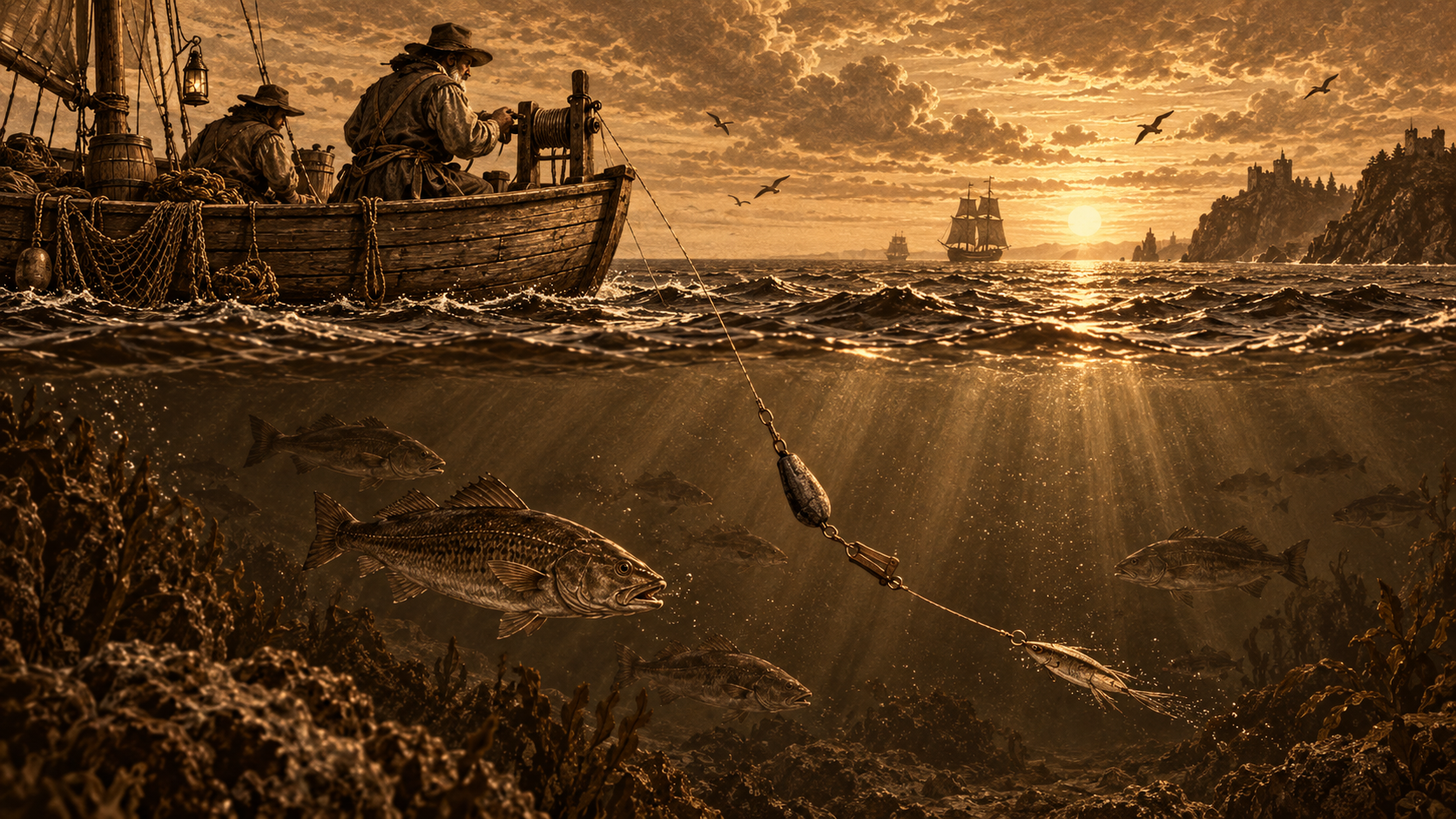
    For generations, trolling anglers faced the same problem: a lure moving beautifully behind the boat was of little use if the fish were holding fifty feet beneath it. The downrigger solved that problem with remarkable simplicity — separate the weight from the fishing tackle, put the lure where the fish are, and let the angler fight the fish on the rod alone.

    Fishing Has Always Been a Question of Depth

    Trolling is among the oldest ways of covering water with a bait or lure, but ordinary trolling has an inherent limitation. A lure behind a moving boat does not simply stay where the angler wants it. Speed, line diameter, lure design, current, and the amount of line behind the boat all influence how deeply it runs.

    For fish holding near the surface, that uncertainty may not matter very much. For fish suspended well below the boat, it matters enormously.

    The basic idea behind the downrigger is therefore older than the modern machine itself: use a separate heavy weight to carry the fishing presentation down into the water column while allowing the rod and fishing line to remain relatively light and independent. What eventually became the modern downrigger turned that simple idea into a repeatable system of controlled-depth trolling.

    From Heavy Weights to Precision Trolling

    Pinning down a single inventor of the downrigger is difficult. Weighted trolling systems existed in various forms before the familiar boat-mounted reel, boom, and cannonball arrangement became standard equipment.

    What is much clearer is when the modern recreational downrigger became indispensable. During the growth of the Great Lakes salmon fishery in the late 1960s and 1970s, anglers suddenly had a compelling reason to place lures precisely in deep, open water. Early systems could be decidedly homemade — heavy weights, marked line, improvised reels and simple release clips — but the objective was the same as it is today: put the lure at a known depth and keep it there.

    By the mid-1970s, U.S. patents already described downriggers recognizably similar to modern equipment: boat-mounted reels, controlled braking or clutch systems, heavy trolling weights, booms, and releasable connections between the fishing line and the downrigger cable.

    How a Downrigger Actually Works

    A downrigger does not fight the fish. That distinction is the key to understanding the entire system.

    The downrigger carries a heavy weight — traditionally called a cannonball — on its own cable or line. The angler’s fishing line is temporarily connected to the downrigger through a release clip.

    The boat begins trolling—the lure trails behind the weight at whatever setback the angler chooses. The angler then lowers the downrigger weight to the desired depth.

    When a fish strikes hard enough, the fishing line pulls free from the release. At that instant, the downrigger has finished its job. The angler is connected directly to the fish through the rod, reel, and fishing line, without having to fight the heavy downrigger weight.

    The Advantage Is Not Depth. It Is Repeatable Depth.

    It is tempting to think of a downrigger simply as a device for fishing deep. That understates its real value.

    The important word is control.

    Suppose a sounder shows fish consistently holding around 62 feet. An angler using conventional trolling tackle may know that a lure is running somewhere below the surface, but estimating its precise depth can involve line length, speed, lure characteristics, and a fair amount of educated guessing.

    A downrigger lets the angler set the presentation at a measured depth and return it there repeatedly. That capability becomes especially valuable when fish relate to changes in water temperature, bait concentrations, structure, or a thermocline.

    Reading the Water Column

    Modern sonar has made the downrigger even more useful. The two technologies complement each other almost perfectly.

    The sounder tells the angler where fish and bait are positioned. The downrigger provides a mechanical way to place the bait or lure at that depth.

    If bait is concentrated at 45 feet over 120 feet of water, there is little reason to drag a lure along the bottom. If suspended fish suddenly move deeper as sunlight increases, you can lower the presentation accordingly.

    That combination of electronics and mechanical depth control transformed trolling from an exercise in approximation into something much closer to deliberate placement.

    Blowback: The Depth Counter Is Not the Whole Story

    A downrigger may say that 80 feet of cable has been released, but that does not necessarily mean the cannonball is directly beneath the boat at a depth of exactly 80 feet.

    As the boat moves, water pressure pushes the cable and weight backward. Anglers call this blowback.

    The faster the boat travels, the greater that effect generally becomes. Current, cable diameter, and cannonball weight also influence the angle. Heavier or more hydrodynamic weights, thinner cable or braid, and slower trolling speeds can reduce blowback.

    Experienced downrigger fishermen learn to treat the depth counter as an extremely useful reference rather than an infallible measurement; if fish strike when a particular setup is showing 74 feet on the counter, returning to that setting may be more useful than arguing over whether the lure was actually 69, 71, or 74 feet beneath the surface.

    Manual Versus Electric

    The fundamental mechanism has changed remarkably little. A manual downrigger uses a hand crank to retrieve the weight, while a clutch, drag, or brake controls its descent.

    An electric downrigger uses a motor to retrieve the weight and may add features such as automatic stopping, depth cycling and other electronic controls.

    Electric models are convenient, particularly when heavy weights are repeatedly deployed into deep water. Manual downriggers, however, retain advantages of their own: mechanical simplicity, independence from the boat’s electrical system and comparatively straightforward maintenance.

    Neither approach changes the basic fishing principle. Both descend from the same weighted controlled-depth system.

    A Design That Refused to Disappear

    Fishing tackle history includes plenty of products that vanished when their manufacturers moved on. The Penn Fathom-Master downrigger proved unusually persistent.

    After Penn discontinued the Fathom-Master line, demand for replacement parts remained strong enough that Troll-Master began manufacturing a limited number of components for existing units. From there, the company decided not to reinvent the basic mechanism, but to develop a new downrigger inspired by that proven design.

    That became the Seahorse. Prototypes underwent corrosion, strength, and operational testing, and Troll-Master officially launched the Seahorse line at ICAST in 2016.

    The result is a modern manual downrigger that keeps the familiar reel, boom, controlled descent, weight, and release concept while being built for both freshwater and saltwater use. Readers interested in that design lineage can see the Troll-Master Seahorse downrigger directly from the manufacturer.

    The Downrigger in the Electronics Age

    Fishing boats have changed dramatically since the Great Lakes trolling boom. Today’s angler may have GPS mapping, side imaging, down imaging, live sonar, detailed temperature information, and sophisticated trolling motors aboard a single boat.

    Yet beside all of that electronics may sit a remarkably mechanical device: a spool, a cable, a boom, and a heavy weight.

    There is a reason. Electronics can show an angler where the fish are. The downrigger does something entirely different.

    It puts the lure there.

    A Simple Machine With a Very Important Job

    Strip away the depth counter, swiveling mounts, rod holders, electric motors, and modern materials, and the downrigger becomes almost elemental: a heavy weight takes a lure to depth, a release separates that weight from the fish, and a reel brings the weight home again.

    Yet from that simple arrangement came one of trolling’s most important advances — the ability to stop fishing somewhere in the water column and start fishing exactly where you intend to fish.

    Nearly everything about modern angling has become more sophisticated. The downrigger’s great achievement is that its central idea never needed to.

    Sources & Notes

    This article draws on historical accounts of controlled-depth trolling, early downrigger patents, and manufacturer histories. Particular thanks to Troll-Master and Seahorse Downriggers for preserving and documenting the lineage of the Penn Fathom-Master design and its evolution into the modern Seahorse downrigger.

  • The Chum Line: History, Science, and the Art of Bringing Fish to You

    The Chum Line: History, Science, and the Art of Bringing Fish to You

    Chumming is one of fishing’s oldest forms of persuasion. Rather than searching endlessly for fish, the angler creates a trail of scent, oil and food particles that travels with the water and invites the fish to come looking. Simple in principle, remarkably effective in practice, the chum line sits at the intersection of tradition, fish behavior, current and a little bit of angling craft.

    What Is Chumming?

    Chumming is the practice of putting small amounts of bait, fish pieces, oils, or other food material into the water to attract fish toward a particular area. Instead of relying only on a baited hook or lure to find a passing fish, the angler creates a feeding trail that can draw fish from farther away and encourage them to remain nearby.

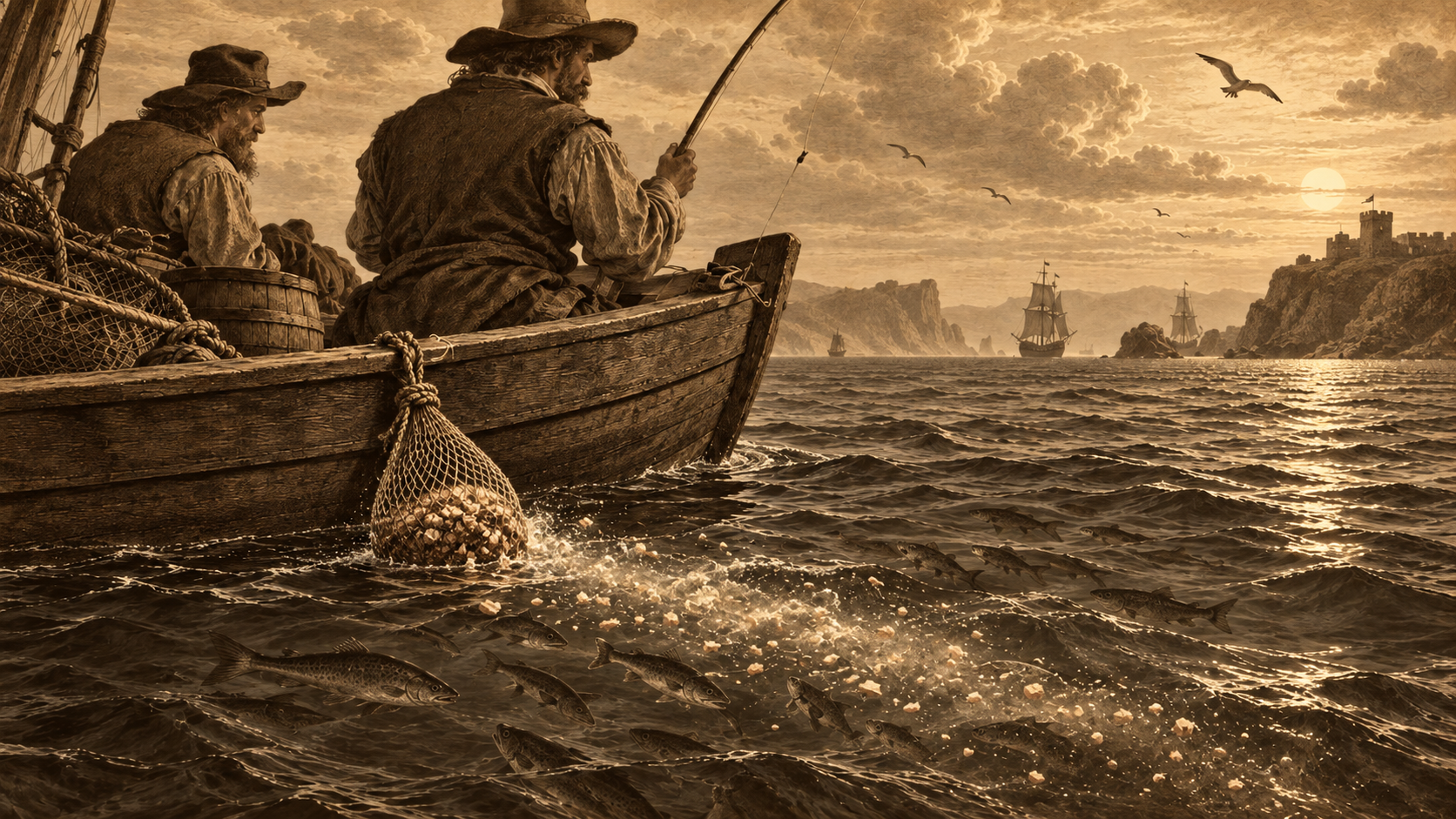
    The chum itself may take many forms. Offshore anglers often use ground or chopped baitfish, frozen blocks of fish and oil, or mixtures held in a mesh chum bag. Other fisheries may use cut bait, shellfish, pellets, grain, or locally available material. The goal is generally the same: release enough scent and food particles into the water to attract attention without giving the fish so much to eat that they lose interest in the angler’s bait.

    A properly established chum line is not simply a pile of bait beside the boat. Current carries scent, oils, and suspended particles away from the source, creating a trail that fish can follow back toward the angler. Where the chum is placed, how quickly it is released, the strength of the current, and even the size of the particles can determine whether that trail works effectively.

    Why Chumming Works

    Fish live in a moving chemical environment. Scent, dissolved oils and tiny food particles can travel with the current well beyond the point where the chum first enters the water. Species with strong senses of smell or feeding responses may detect that trail and begin moving toward its source.

    The current does much of the work. A steady flow can stretch the chum into a long, narrow feeding lane, while weak or shifting water may cause the trail to disperse unevenly. That is why experienced anglers pay close attention to tide, wind, and boat position before deploying a chum bag or ladling chum overboard.

    There is also a behavioral effect. Once one or two fish begin feeding, the activity can attract others and create competition. The ideal chum line brings fish close enough to investigate and feed, while still leaving them eager to take the hooked bait or lure the angler presents.

    The Chum Bag

    A chum bag is a simple delivery system: a mesh or perforated container filled with chum and suspended in the water so the current can gradually wash scent, oil, and small particles through it. The bag keeps the bulk of the material contained while allowing the attractive portion to disperse.

    Mesh size matters. A coarse mesh releases larger pieces and can create a stronger feeding response, but it may also empty too quickly. A finer mesh slows release and can keep a chum line working longer. Water temperature, current speed, and the type of chum inside the bag all affect how quickly it breaks down.

    Placement matters just as much. A chum bag hung from the stern may create a trail that carries directly away from the boat, while a bag lowered deeper can target fish holding below the surface. Some anglers periodically shake or lift the bag to release a fresh pulse of particles; others let the current do the work.

    What Goes Into Chum?

    There is no single recipe for chum. In saltwater fishing, common ingredients include ground or chopped baitfish, fish scraps, menhaden or other oily baitfish, shrimp, squid, shellfish, and commercially prepared frozen chum blocks. Some anglers add fish oil or other scent-producing liquids to strengthen the trail.

    The best chum usually matches the food already present in the fishery. A mixture based on local baitfish may be more natural and effective than an unfamiliar ingredient. In some situations, dry pellets or grain-based materials are also used, especially where they are legal and appropriate for the target species.

    The key is attraction, not feeding. Chum should create enough scent and suspended material to hold a fish’s attention, but not so much food that the fish fill up before reaching the hook. Too much chum can be as ineffective as too little, which is why experienced anglers often favor a steady, controlled release over dumping large amounts into the water at once.

    Reading the Current

    A chum line only works if the angler understands where the water is carrying it. From a boat, the current determines the trail’s direction and shape. A steady current can create a long, predictable path, while swirling or inconsistent water may scatter the chum and make it harder to keep fish positioned where you want them.

    Boat position is therefore critical. The goal is to place the boat so the chum trail moves through the area where fish are likely to be holding, then present the bait naturally within that same path. When the bait and the chum are moving together, the hooked offering becomes part of the feeding stream rather than something separate from it.

    Depth matters too. Surface chum may attract fish upward, while heavier particles or a deeper chum bag can reach fish holding lower in the water column. In many situations, the most effective approach is to think of the chum line as a three-dimensional path rather than a simple streak floating behind the boat.

    Common Mistakes When Chumming

    The most common mistake is using too much chum. A heavy dump of bait may create an immediate feeding response, but it can also scatter fish, fill them up, or cause the chum to sink away from the area where the hooked bait is being presented. A steady, controlled release is usually more useful than a sudden flood of food.

    Another mistake is ignoring the current. If the chum line is drifting away from the fishing area, the angler may be attracting fish to the wrong place. Boat position, wind, tide, and depth all need to work together so the chum trail and the baited hook occupy the same general path through the water.

    Finally, anglers sometimes treat chumming as a fixed recipe rather than a technique that must be adjusted. Current speed, water temperature, target species, and bait availability can all change the way chum should be prepared and delivered. The most effective chum line is usually one that you watch and adjust as conditions change.

    Where Did the Word “Chum” Come From?

    The fishing sense of the word chum is American and appears in print by the mid-19th century. Merriam-Webster dates the noun meaning fish bait to 1857 and notes that the term appears to have been first used along the New England coast. Its exact origin is uncertain. One theory connects it to an old Scottish dialect word chum, meaning food or provisions.

    The practice itself is older than the printed word. An 1881 report of the U.S. Commissioner of Fish and Fisheries described New England mackerel fishermen using ground oily bait that was sometimes called “chum” or “stosh.” The report explained that Massachusetts fishermen were already using ground bait to “toll” fish toward their vessels at the beginning of the 1800s, with the bait spreading through the water as the schooner drifted.

    That historical description is strikingly familiar. More than two centuries later, the principle has hardly changed: release a controlled trail of food and scent into moving water, let fish follow it toward the source, and place the angler’s bait where the feeding activity develops. The equipment has evolved, but the basic idea behind the chum line remains much the same.

    Chumming Around the World

    The technique is certainly not limited to anglers who call it chumming. In Australia and New Zealand, the same practice is commonly known as berley or burley: bait or ground bait introduced into the water to attract fish and hold them near the fishing area. Australian records of the word berley reach back into the 19th century, although its deeper linguistic origin remains uncertain.

    The materials change with geography and local fishing traditions, but the principle remains remarkably consistent. Anglers create a controlled stream of scent and edible particles, use wind or current to carry it away from the fishing position, and then present their bait or lure where approaching fish encounter that trail. Australian fishing sources describe burley in essentially the same terms American anglers use for chum.

    That shared technique reminds us that chumming is less about a particular recipe than about understanding how fish find food. Whether it is called chum, berley, burley, or ground bait, the angler is using scent, current, and feeding behavior to concentrate fish within reach.

    Where and When Chumming Is Used

    Chumming is especially useful when fish are spread over a large area or holding at a depth that makes them difficult to locate consistently. Offshore anglers may use chum to draw pelagic species toward the boat, while reef and bottom fishermen use it to concentrate fish around structure. Shark fishermen have long relied on chum trails because scent can travel far beyond the range of sight.

    Inshore anglers may chum around bridges, passes, channels, docks, and other areas where current can carry a scent trail naturally through productive water. In freshwater, variations of the same idea are used for species such as catfish, carp and panfish, although the ingredients and methods may be very different from saltwater chumming.

    Chumming is most effective when it complements the conditions rather than trying to overcome them. Strong current, suitable depth, active baitfish, and predictable fish movement can all make a chum line more effective. Just as important, anglers should always check local regulations before using chum, because rules vary by location, species, and water type.

    A Technique Built on Patience

    At its heart, chumming is a simple idea: put something attractive into the water, let the current carry the message, and wait for fish to respond. The technique doesn’t require sophisticated equipment, but it rewards observation and restraint.

    A productive chum line depends on reading the water, understanding how quickly the chum is dispersing, and adjusting the presentation as conditions change. Too much, too little, too shallow, too deep, or simply in the wrong current can make the difference between a lively feeding lane and an empty one.

    That is part of what makes chumming such an enduring fishing technique. The materials and equipment may have changed, but the angler is still doing what generations before him did: using scent, current, and patience to persuade fish to come within reach.

    Before You Chum

    Before using chum, check the current fishing regulations for the water you are fishing. Rules may vary by state, species, location, and method, particularly in protected areas or fisheries with specific bait restrictions.
    Sources & Notes