“… having withall regard to the bigness or littleness of your hook” — Izaak Walton, The Compleat Angler (1653)
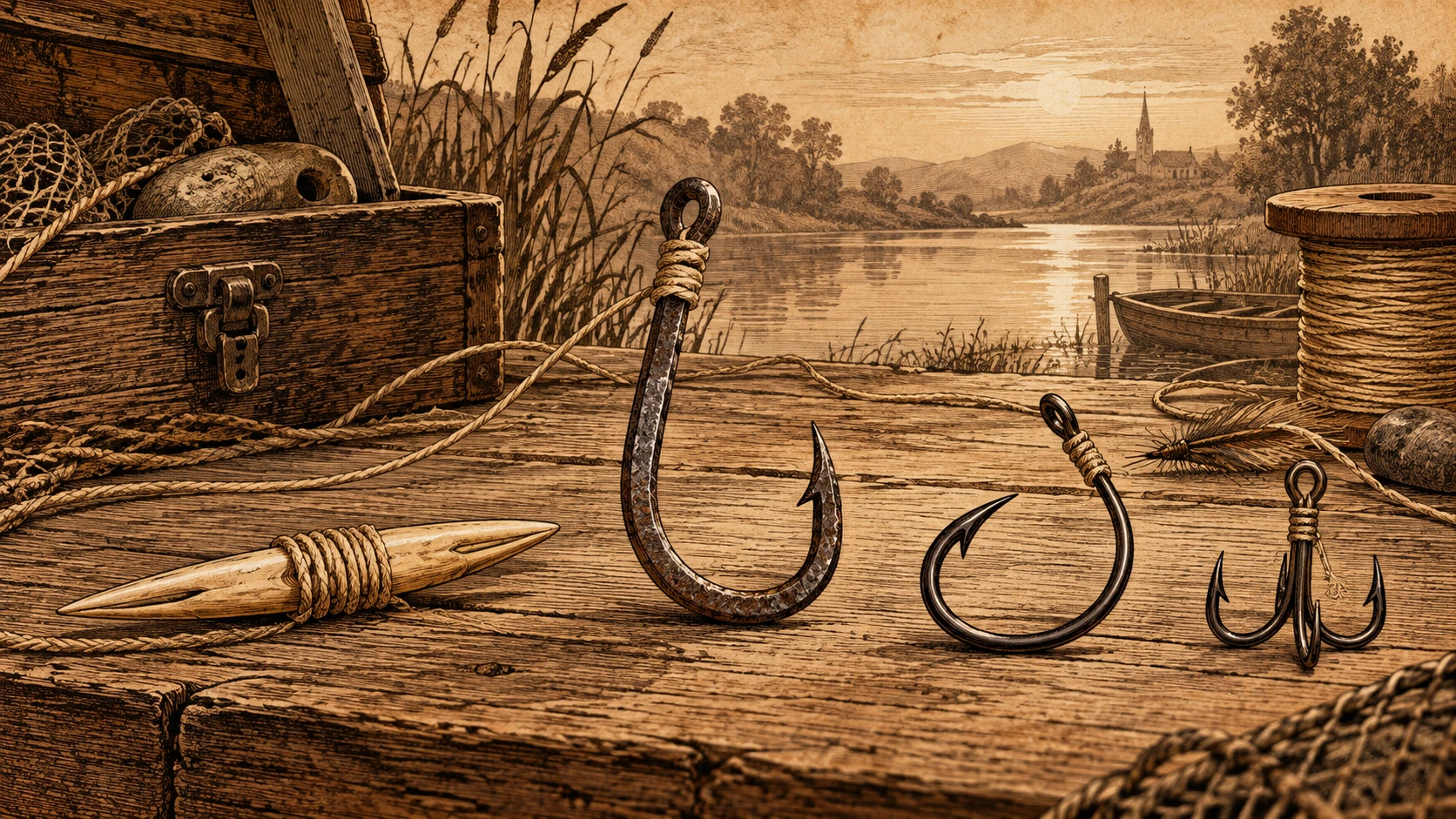
Long before Walton wrote about fishing hooks, anglers used a simple device called a gorge: a small, straight piece of bone or wood tied to a line near its middle. A fish swallowed it, and the piece turned crosswise when the line was pulled. Hooks have changed enormously since then, but Walton’s point still holds: size matters.
How Hook Sizes Work
Hook labels can seem backward. In the numbered sizes, a higher number means a smaller hook: size 8 is smaller than size 4, which is smaller than size 1. After size 1, the labels switch to aughts—1/0, 2/0, 3/0—and the direction reverses: 3/0 is larger than 2/0.
A size number does not guarantee identical dimensions across hook styles or brands. Check the gap—the opening between the point and the shank—along with the hook’s shape and wire thickness. The gap needs room for the bait while leaving the point exposed; the right size depends on what you are presenting and the fish you expect to catch.
Shape Matters Too
A J-hook has an exposed point and is used with many baits and lures. A circle hook curves its point inward and is commonly used with natural bait; it tends to catch in the corner of a fish’s mouth. A treble hook has three points and is common on hard lures. The size printed on the package tells only part of the story—shape and gap matter just as much.
Starting Sizes for Familiar Fish
- Panfish: Try a size 6 or 8 with a small worm piece.
- Bass: A 3/0 hook is a common starting point for a soft-plastic worm; choose a hook that fits the plastic.
- Redfish, seatrout, or snook: For live shrimp or a small minnow, start around size 1 or 1/0. Move up as the bait gets larger.
The simplest check is to rig the bait and look at the hook. It should hold the bait securely while leaving enough gap and an exposed point to catch. Start with the package size, then judge the actual hook in your hand—that is more useful than treating any number as a guarantee.