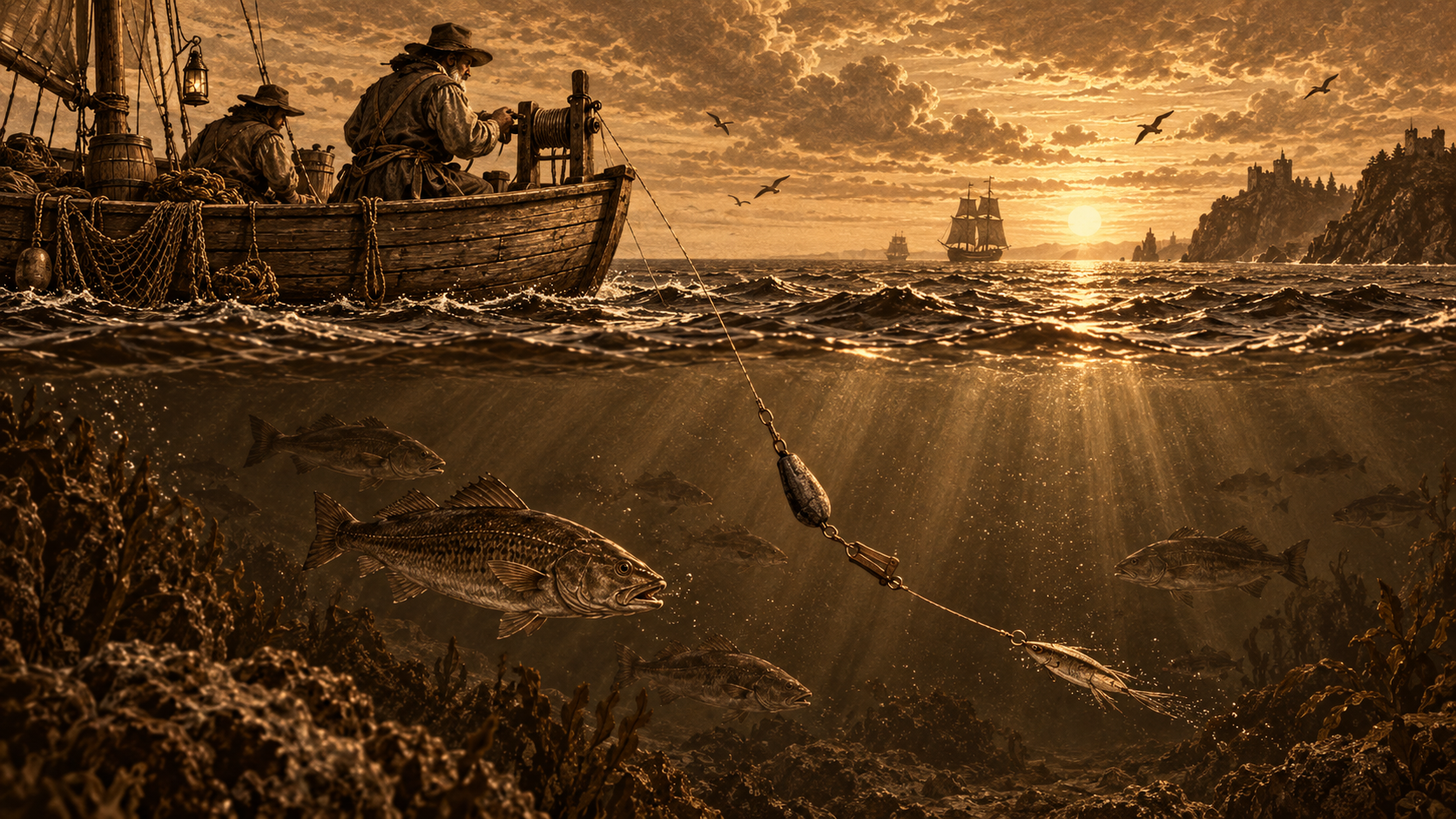
For generations, trolling anglers faced the same problem: a lure moving beautifully behind the boat was of little use if the fish were holding fifty feet beneath it. The downrigger solved that problem with remarkable simplicity — separate the weight from the fishing tackle, put the lure where the fish are, and let the angler fight the fish on the rod alone.
Fishing Has Always Been a Question of Depth
Trolling is among the oldest ways of covering water with a bait or lure, but ordinary trolling has an inherent limitation. A lure behind a moving boat does not simply stay where the angler wants it. Speed, line diameter, lure design, current, and the amount of line behind the boat all influence how deeply it runs.
For fish holding near the surface, that uncertainty may not matter very much. For fish suspended well below the boat, it matters enormously.
The basic idea behind the downrigger is therefore older than the modern machine itself: use a separate heavy weight to carry the fishing presentation down into the water column while allowing the rod and fishing line to remain relatively light and independent. What eventually became the modern downrigger turned that simple idea into a repeatable system of controlled-depth trolling.
From Heavy Weights to Precision Trolling
Pinning down a single inventor of the downrigger is difficult. Weighted trolling systems existed in various forms before the familiar boat-mounted reel, boom, and cannonball arrangement became standard equipment.
What is much clearer is when the modern recreational downrigger became indispensable. During the growth of the Great Lakes salmon fishery in the late 1960s and 1970s, anglers suddenly had a compelling reason to place lures precisely in deep, open water. Early systems could be decidedly homemade — heavy weights, marked line, improvised reels and simple release clips — but the objective was the same as it is today: put the lure at a known depth and keep it there.
By the mid-1970s, U.S. patents already described downriggers recognizably similar to modern equipment: boat-mounted reels, controlled braking or clutch systems, heavy trolling weights, booms, and releasable connections between the fishing line and the downrigger cable.
How a Downrigger Actually Works
A downrigger does not fight the fish. That distinction is the key to understanding the entire system.
The downrigger carries a heavy weight — traditionally called a cannonball — on its own cable or line. The angler’s fishing line is temporarily connected to the downrigger through a release clip.
The boat begins trolling—the lure trails behind the weight at whatever setback the angler chooses. The angler then lowers the downrigger weight to the desired depth.
When a fish strikes hard enough, the fishing line pulls free from the release. At that instant, the downrigger has finished its job. The angler is connected directly to the fish through the rod, reel, and fishing line, without having to fight the heavy downrigger weight.
The Advantage Is Not Depth. It Is Repeatable Depth.
It is tempting to think of a downrigger simply as a device for fishing deep. That understates its real value.
The important word is control.
Suppose a sounder shows fish consistently holding around 62 feet. An angler using conventional trolling tackle may know that a lure is running somewhere below the surface, but estimating its precise depth can involve line length, speed, lure characteristics, and a fair amount of educated guessing.
A downrigger lets the angler set the presentation at a measured depth and return it there repeatedly. That capability becomes especially valuable when fish relate to changes in water temperature, bait concentrations, structure, or a thermocline.
Reading the Water Column
Modern sonar has made the downrigger even more useful. The two technologies complement each other almost perfectly.
The sounder tells the angler where fish and bait are positioned. The downrigger provides a mechanical way to place the bait or lure at that depth.
If bait is concentrated at 45 feet over 120 feet of water, there is little reason to drag a lure along the bottom. If suspended fish suddenly move deeper as sunlight increases, you can lower the presentation accordingly.
That combination of electronics and mechanical depth control transformed trolling from an exercise in approximation into something much closer to deliberate placement.
Blowback: The Depth Counter Is Not the Whole Story
A downrigger may say that 80 feet of cable has been released, but that does not necessarily mean the cannonball is directly beneath the boat at a depth of exactly 80 feet.
As the boat moves, water pressure pushes the cable and weight backward. Anglers call this blowback.
The faster the boat travels, the greater that effect generally becomes. Current, cable diameter, and cannonball weight also influence the angle. Heavier or more hydrodynamic weights, thinner cable or braid, and slower trolling speeds can reduce blowback.
Experienced downrigger fishermen learn to treat the depth counter as an extremely useful reference rather than an infallible measurement; if fish strike when a particular setup is showing 74 feet on the counter, returning to that setting may be more useful than arguing over whether the lure was actually 69, 71, or 74 feet beneath the surface.
Manual Versus Electric
The fundamental mechanism has changed remarkably little. A manual downrigger uses a hand crank to retrieve the weight, while a clutch, drag, or brake controls its descent.
An electric downrigger uses a motor to retrieve the weight and may add features such as automatic stopping, depth cycling and other electronic controls.
Electric models are convenient, particularly when heavy weights are repeatedly deployed into deep water. Manual downriggers, however, retain advantages of their own: mechanical simplicity, independence from the boat’s electrical system and comparatively straightforward maintenance.
Neither approach changes the basic fishing principle. Both descend from the same weighted controlled-depth system.
A Design That Refused to Disappear
Fishing tackle history includes plenty of products that vanished when their manufacturers moved on. The Penn Fathom-Master downrigger proved unusually persistent.
After Penn discontinued the Fathom-Master line, demand for replacement parts remained strong enough that Troll-Master began manufacturing a limited number of components for existing units. From there, the company decided not to reinvent the basic mechanism, but to develop a new downrigger inspired by that proven design.
That became the Seahorse. Prototypes underwent corrosion, strength, and operational testing, and Troll-Master officially launched the Seahorse line at ICAST in 2016.
The result is a modern manual downrigger that keeps the familiar reel, boom, controlled descent, weight, and release concept while being built for both freshwater and saltwater use. Readers interested in that design lineage can see the Troll-Master Seahorse downrigger directly from the manufacturer.
The Downrigger in the Electronics Age
Fishing boats have changed dramatically since the Great Lakes trolling boom. Today’s angler may have GPS mapping, side imaging, down imaging, live sonar, detailed temperature information, and sophisticated trolling motors aboard a single boat.
Yet beside all of that electronics may sit a remarkably mechanical device: a spool, a cable, a boom, and a heavy weight.
There is a reason. Electronics can show an angler where the fish are. The downrigger does something entirely different.
It puts the lure there.
A Simple Machine With a Very Important Job
Strip away the depth counter, swiveling mounts, rod holders, electric motors, and modern materials, and the downrigger becomes almost elemental: a heavy weight takes a lure to depth, a release separates that weight from the fish, and a reel brings the weight home again.
Yet from that simple arrangement came one of trolling’s most important advances — the ability to stop fishing somewhere in the water column and start fishing exactly where you intend to fish.
Nearly everything about modern angling has become more sophisticated. The downrigger’s great achievement is that its central idea never needed to.
Sources & Notes
This article draws on historical accounts of controlled-depth trolling, early downrigger patents, and manufacturer histories. Particular thanks to Troll-Master and Seahorse Downriggers for preserving and documenting the lineage of the Penn Fathom-Master design and its evolution into the modern Seahorse downrigger.