
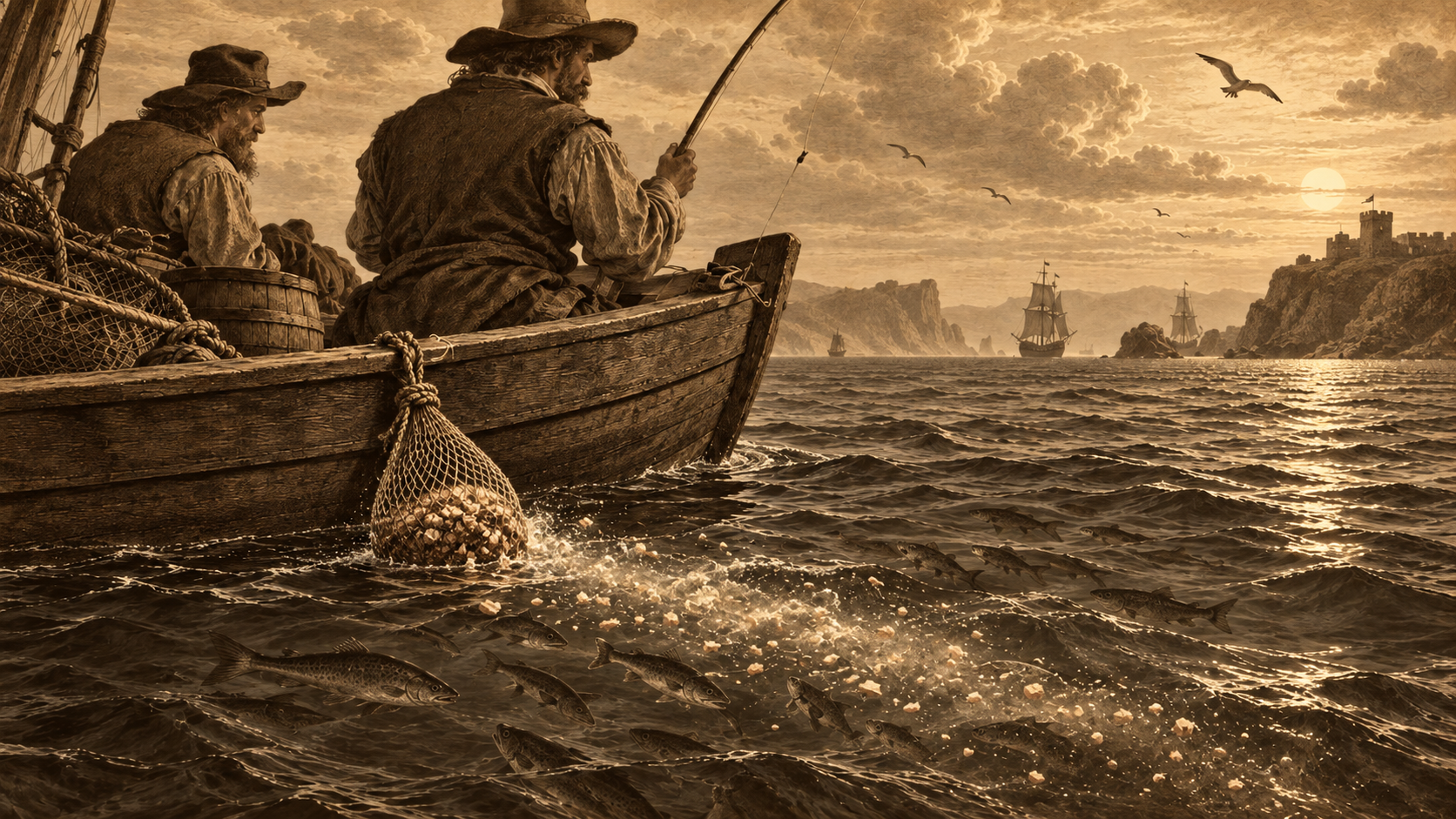
Chumming is one of fishing’s oldest forms of persuasion. Rather than searching endlessly for fish, the angler creates a trail of scent, oil and food particles that travels with the water and invites the fish to come looking. Simple in principle, remarkably effective in practice, the chum line sits at the intersection of tradition, fish behavior, current and a little bit of angling craft.
What Is Chumming?
Chumming is the practice of putting small amounts of bait, fish pieces, oils, or other food material into the water to attract fish toward a particular area. Instead of relying only on a baited hook or lure to find a passing fish, the angler creates a feeding trail that can draw fish from farther away and encourage them to remain nearby.
The chum itself may take many forms. Offshore anglers often use ground or chopped baitfish, frozen blocks of fish and oil, or mixtures held in a mesh chum bag. Other fisheries may use cut bait, shellfish, pellets, grain, or locally available material. The goal is generally the same: release enough scent and food particles into the water to attract attention without giving the fish so much to eat that they lose interest in the angler’s bait.
A properly established chum line is not simply a pile of bait beside the boat. Current carries scent, oils, and suspended particles away from the source, creating a trail that fish can follow back toward the angler. Where the chum is placed, how quickly it is released, the strength of the current, and even the size of the particles can determine whether that trail works effectively.
Why Chumming Works
Fish live in a moving chemical environment. Scent, dissolved oils and tiny food particles can travel with the current well beyond the point where the chum first enters the water. Species with strong senses of smell or feeding responses may detect that trail and begin moving toward its source.
The current does much of the work. A steady flow can stretch the chum into a long, narrow feeding lane, while weak or shifting water may cause the trail to disperse unevenly. That is why experienced anglers pay close attention to tide, wind, and boat position before deploying a chum bag or ladling chum overboard.
There is also a behavioral effect. Once one or two fish begin feeding, the activity can attract others and create competition. The ideal chum line brings fish close enough to investigate and feed, while still leaving them eager to take the hooked bait or lure the angler presents.
The Chum Bag
A chum bag is a simple delivery system: a mesh or perforated container filled with chum and suspended in the water so the current can gradually wash scent, oil, and small particles through it. The bag keeps the bulk of the material contained while allowing the attractive portion to disperse.
Mesh size matters. A coarse mesh releases larger pieces and can create a stronger feeding response, but it may also empty too quickly. A finer mesh slows release and can keep a chum line working longer. Water temperature, current speed, and the type of chum inside the bag all affect how quickly it breaks down.
Placement matters just as much. A chum bag hung from the stern may create a trail that carries directly away from the boat, while a bag lowered deeper can target fish holding below the surface. Some anglers periodically shake or lift the bag to release a fresh pulse of particles; others let the current do the work.
What Goes Into Chum?
There is no single recipe for chum. In saltwater fishing, common ingredients include ground or chopped baitfish, fish scraps, menhaden or other oily baitfish, shrimp, squid, shellfish, and commercially prepared frozen chum blocks. Some anglers add fish oil or other scent-producing liquids to strengthen the trail.
The best chum usually matches the food already present in the fishery. A mixture based on local baitfish may be more natural and effective than an unfamiliar ingredient. In some situations, dry pellets or grain-based materials are also used, especially where they are legal and appropriate for the target species.
The key is attraction, not feeding. Chum should create enough scent and suspended material to hold a fish’s attention, but not so much food that the fish fill up before reaching the hook. Too much chum can be as ineffective as too little, which is why experienced anglers often favor a steady, controlled release over dumping large amounts into the water at once.
Reading the Current
A chum line only works if the angler understands where the water is carrying it. From a boat, the current determines the trail’s direction and shape. A steady current can create a long, predictable path, while swirling or inconsistent water may scatter the chum and make it harder to keep fish positioned where you want them.
Boat position is therefore critical. The goal is to place the boat so the chum trail moves through the area where fish are likely to be holding, then present the bait naturally within that same path. When the bait and the chum are moving together, the hooked offering becomes part of the feeding stream rather than something separate from it.
Depth matters too. Surface chum may attract fish upward, while heavier particles or a deeper chum bag can reach fish holding lower in the water column. In many situations, the most effective approach is to think of the chum line as a three-dimensional path rather than a simple streak floating behind the boat.
Common Mistakes When Chumming
The most common mistake is using too much chum. A heavy dump of bait may create an immediate feeding response, but it can also scatter fish, fill them up, or cause the chum to sink away from the area where the hooked bait is being presented. A steady, controlled release is usually more useful than a sudden flood of food.
Another mistake is ignoring the current. If the chum line is drifting away from the fishing area, the angler may be attracting fish to the wrong place. Boat position, wind, tide, and depth all need to work together so the chum trail and the baited hook occupy the same general path through the water.
Finally, anglers sometimes treat chumming as a fixed recipe rather than a technique that must be adjusted. Current speed, water temperature, target species, and bait availability can all change the way chum should be prepared and delivered. The most effective chum line is usually one that you watch and adjust as conditions change.
Where Did the Word “Chum” Come From?
The fishing sense of the word chum is American and appears in print by the mid-19th century. Merriam-Webster dates the noun meaning fish bait to 1857 and notes that the term appears to have been first used along the New England coast. Its exact origin is uncertain. One theory connects it to an old Scottish dialect word chum, meaning food or provisions.
The practice itself is older than the printed word. An 1881 report of the U.S. Commissioner of Fish and Fisheries described New England mackerel fishermen using ground oily bait that was sometimes called “chum” or “stosh.” The report explained that Massachusetts fishermen were already using ground bait to “toll” fish toward their vessels at the beginning of the 1800s, with the bait spreading through the water as the schooner drifted.
That historical description is strikingly familiar. More than two centuries later, the principle has hardly changed: release a controlled trail of food and scent into moving water, let fish follow it toward the source, and place the angler’s bait where the feeding activity develops. The equipment has evolved, but the basic idea behind the chum line remains much the same.
Chumming Around the World
The technique is certainly not limited to anglers who call it chumming. In Australia and New Zealand, the same practice is commonly known as berley or burley: bait or ground bait introduced into the water to attract fish and hold them near the fishing area. Australian records of the word berley reach back into the 19th century, although its deeper linguistic origin remains uncertain.
The materials change with geography and local fishing traditions, but the principle remains remarkably consistent. Anglers create a controlled stream of scent and edible particles, use wind or current to carry it away from the fishing position, and then present their bait or lure where approaching fish encounter that trail. Australian fishing sources describe burley in essentially the same terms American anglers use for chum.
That shared technique reminds us that chumming is less about a particular recipe than about understanding how fish find food. Whether it is called chum, berley, burley, or ground bait, the angler is using scent, current, and feeding behavior to concentrate fish within reach.
Where and When Chumming Is Used
Chumming is especially useful when fish are spread over a large area or holding at a depth that makes them difficult to locate consistently. Offshore anglers may use chum to draw pelagic species toward the boat, while reef and bottom fishermen use it to concentrate fish around structure. Shark fishermen have long relied on chum trails because scent can travel far beyond the range of sight.
Inshore anglers may chum around bridges, passes, channels, docks, and other areas where current can carry a scent trail naturally through productive water. In freshwater, variations of the same idea are used for species such as catfish, carp and panfish, although the ingredients and methods may be very different from saltwater chumming.
Chumming is most effective when it complements the conditions rather than trying to overcome them. Strong current, suitable depth, active baitfish, and predictable fish movement can all make a chum line more effective. Just as important, anglers should always check local regulations before using chum, because rules vary by location, species, and water type.
A Technique Built on Patience
At its heart, chumming is a simple idea: put something attractive into the water, let the current carry the message, and wait for fish to respond. The technique doesn’t require sophisticated equipment, but it rewards observation and restraint.
A productive chum line depends on reading the water, understanding how quickly the chum is dispersing, and adjusting the presentation as conditions change. Too much, too little, too shallow, too deep, or simply in the wrong current can make the difference between a lively feeding lane and an empty one.
That is part of what makes chumming such an enduring fishing technique. The materials and equipment may have changed, but the angler is still doing what generations before him did: using scent, current, and patience to persuade fish to come within reach.
Before You Chum
Before using chum, check the current fishing regulations for the water you are fishing. Rules may vary by state, species, location, and method, particularly in protected areas or fisheries with specific bait restrictions.